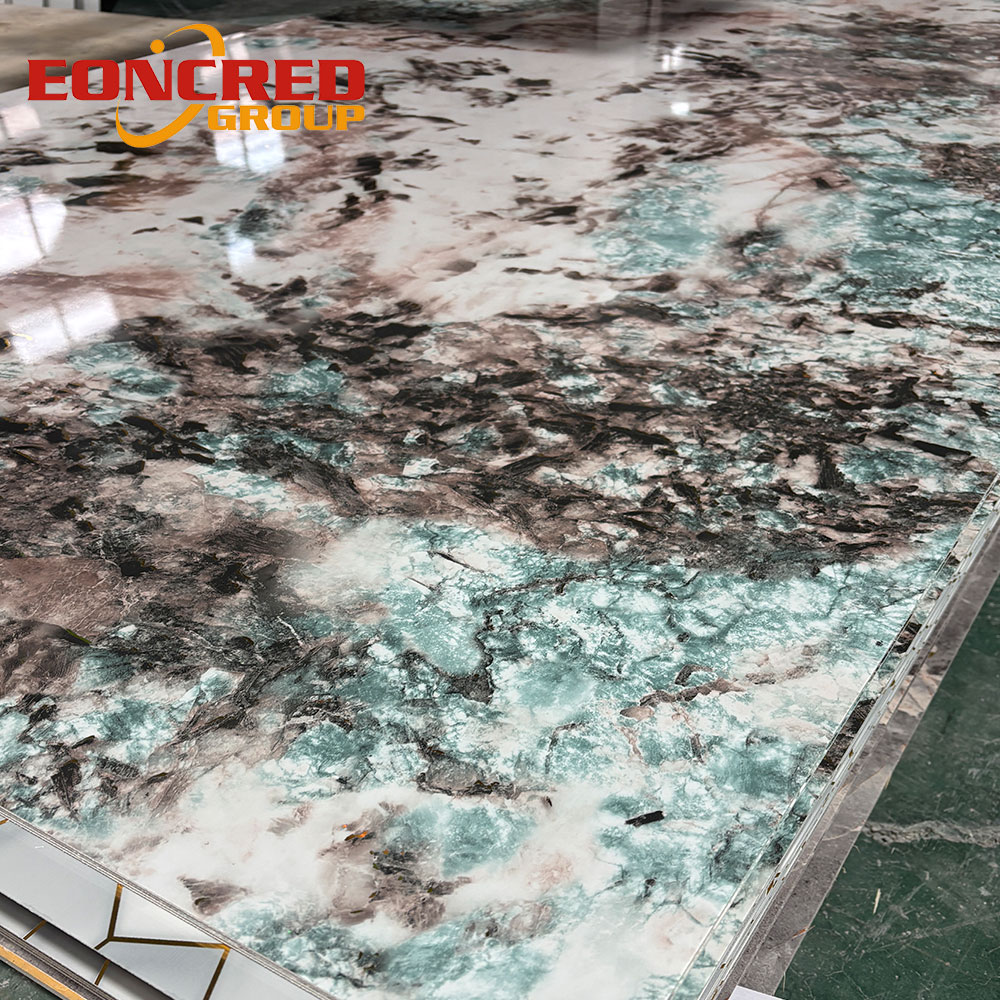
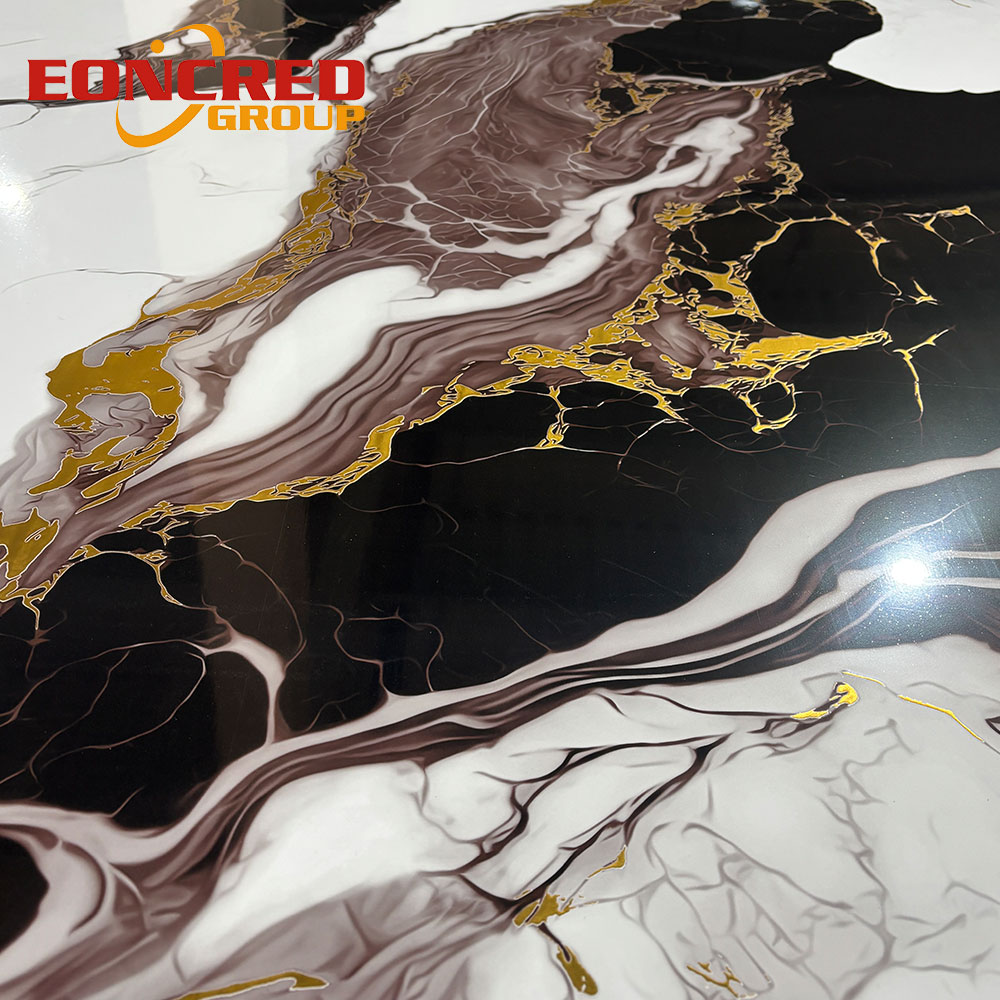
UV marble sheets are popular in modern decoration for their marble-like appearance, durability and cost-effectiveness. Unlike natural marble, they are multi-layer composites with each layer tailored for specific functions (structural stability, aesthetics, protection). This article explores their detailed composition and core raw materials.
I. Core Composition: Multi-layer Structure and Raw Materials
A standard UV marble sheet has 4-6 functional layers, whose combination ensures overall performance like hardness, water resistance, scratch resistance and decorativeness.
1. Protective Film Layer (Surface Outermost Layer)
The outermost temporary protective layer is made of PE or PP plastic film, preventing scratches and dust during transportation and installation. It’s easily peelable, with high-transparency plastic particles as raw materials to avoid obscuring the underlying layers.
This layer is critical for durability (hardness 3H-6H, scratch-resistant) and has excellent stain resistance and easy cleanability due to the non-porous cured resin surface.
This layer replicates realistic marble textures, made of high-resolution printed/thermal transfer film (PET base + eco-friendly ink). Advanced digital printing ensures precise reproduction of marble veining and colors.
The special ink ensures color stability. High-end products may use 3D printing for concave-convex textures, enhancing tactile and visual similarity to natural marble.
4. Substrate Layer (Core Structural Layer)
As the "backbone" of the sheet, the substrate layer (60%-80% of total thickness) provides structural stability. Common materials are SPC/PVC or WPC, with typical raw material ratios:
PVC resin (30%-45%): Main binding material, water-resistant, flame-retardant; high-quality products use lead-free and formaldehyde-free resin.
Calcium carbonate (50%-60%): Filler enhancing rigidity and stability, reducing cost.
Additives (2%-5%): Plasticizers, stabilizers, flame retardants and lubricants improving processability and safety.
WPC substrates (PVC + wood powder/bamboo fiber) enhance eco-friendliness and strength. MDF/HDF substrates are rarely used due to poor water resistance.
5. Balance/Backing Layer (Optional Bottom Layer)
High-end sheets may have a bottom balance layer (same/similar to substrate) to offset internal stress, prevent warping and improve flatness for better installation adhesion.
II. Auxiliary Materials and Production Process Connection
UV marble sheet composition is closely linked to production. Raw materials go through mixing, extrusion, printing, UV curing and cutting. Key steps:
Substrate production: Mix PVC, calcium carbonate and additives, then extrude into sheets.
Pattern transfer: Laminate decorative film to substrate with controlled temperature (140°C-180°C) and pressure.
UV coating: Apply coating to decorative layer and cure instantly with UV light.
Lamination and cutting: Apply protective film and cut into standard sizes.
III. Environmental and Performance Advantages of the Composition
Composite composition replicates natural marble’s beauty while overcoming its shortcomings. Recycled PVC and natural calcium carbonate make it more eco-friendly than mined natural marble. The PVC-calcium carbonate substrate ensures water resistance and flame retardancy (suitable for bathrooms/kitchens), and the UV coating provides long-term weather resistance against fading.
IV. Conclusion
UV marble sheets are well-designed multi-layer composites. Each layer and its raw materials are carefully selected, giving them advantages of beauty, durability, eco-friendliness and cost-effectiveness—an ideal choice for modern decoration. Understanding their composition helps make informed material selections for home, office or commercial renovations.